Theoretical Legitimacy
of Relational Consciousness
Streaming
An advanced theoretical exploration of RCS as a potential mechanism for enhancing fluid intelligence through optimized relational processing

Executive Summary
Key Finding
The theoretical legitimacy of Relational Consciousness Streaming (RCS) in enhancing fluid intelligence is moderately strong when assessed purely from abstract theorization and alignment with established cognitive principles.
Supporting Evidence
- Fluid intelligence fundamentally relies on relational representation and integration
- Working memory and Gf share flexible binding mechanisms
- Relational training interventions show measurable improvements
- Conscious processing facilitates complex relational reasoning
Critical Limitations
- Zero experimental data directly supporting RCS existence
- RCS remains entirely hypothetical construct
- Legitimacy contingent on established underpinnings
- No validated methods for inducing or measuring RCS
Foundational Link: Fluid Intelligence and Relational Representation
Core Proposition: Fluid Intelligence as Relational Representation
The theoretical exploration of Relational Consciousness Streaming begins with understanding fluid intelligence (Gf) as fundamentally relational. Fluid intelligence is conceptualized as the capacity to perceive and process relationships, particularly in novel situations where prior knowledge offers limited assistance.
This perspective moves beyond viewing fluid intelligence as a general, undefined capacity and instead grounds it in a specific cognitive operation—the mental representation of relational information. The robustness and validity of these mental representations are crucial, as they determine the ability to navigate novel situations and solve problems without relying on previously acquired knowledge.
Neural Substrate
The "dynamic patterns of argument-object (role-filler) bindings" are highlighted as the neural substrate for encoding these relations in the brain, suggesting that the brain's ability to create and maintain complex bindings allows for effective relational thinking.
Key Research: Chuderski (2022) on Fluid Intelligence Emerging from Representing Relations
Adam Chuderski's 2022 paper serves as a cornerstone for understanding the theoretical link between relational representation and fluid intelligence. The work clearly articulates that fluid reasoning can be conceptualized as the mind's ability to represent the key relation or relations pertinent to a given task.
Research Implications
- • Relational representation underpins the enormous flexibility of human thought
- • Efficacy depends on validity and robustness of dynamic bindings
- • Provides precise target for developing models and investigating neural underpinnings
- • Computational models processing relations mirror human fluid intelligence
This reconceptualization is presented as a synthesis of recent findings from cognitive neuroscience, psychology, and computational modeling. The paper emphasizes that effective representation of relations is heavily dependent on the validity and robustness of dynamic patterns of argument-object bindings that encode these relations within the brain.
The Critical Role of Relational Integration
Defining Relational Integration: Binding Mental Representations
Relational integration involves the active combination and manipulation of multiple mental representations to form more complex, structured understandings, particularly focusing on the relationships between these representations.
Core Components
- • Synthesizing information into coherent wholes
- • Representing interconnections explicitly
- • Processing dependencies between elements
- • Maintaining integrated structures in working memory
Examples
- • Solving analogy problems (A:B :: C:?)
- • Completing Raven's Progressive Matrices
- • Integrating multiple rules simultaneously
- • Understanding complex system interactions
The concept is closely tied to "binding" in cognitive science, where disparate pieces of information are linked together to form unified representations. The capacity of working memory is not merely about the number of items that can be held, but more crucially, about the number of bindings that can be simultaneously established and maintained.
Empirical Support: The Relational Integration Task as Strong Predictor
Research Findings
The relational integration task was a numerically better predictor of fluid reasoning than complex span tasks, explaining additional Gf variance that other working memory measures could not account for.
Neural Correlates: The Frontoparietal Network
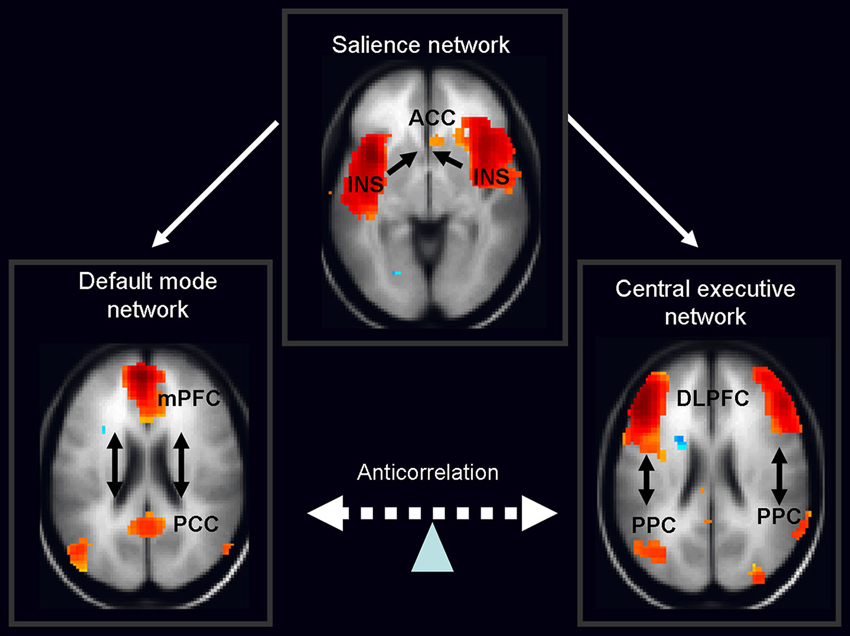
Key Brain Regions
RLPFC
Rostrolateral prefrontal cortex - specialized for relational integration
Inferior Parietal
Identification and representation of visual-spatial relations
Network Coordination
Effective communication and coordination within the frontoparietal network are considered essential for successful relational reasoning and fluid intelligence expression.
Working Memory and Fluid Intelligence: Shared Mechanisms
Implications: Dynamic Binding and Integration
Dynamic Creation
Active process of forming new relational connections in real-time
Binding Strength
Stability and resistance to interference during complex operations
Flexible Updates
Capacity to modify or dissolve bindings as task demands change
Random-Order Access Critical
The ability to handle random-order access to information in working memory is a key differentiator linked to Gf. This places a premium on binding flexibility, requiring a system capable of rapidly forming and utilizing multiple independent bindings that can be accessed and integrated in a non-sequential manner.
This dynamic interplay between stability and flexibility is crucial for adapting to novel situations and generating innovative solutions, which are hallmarks of fluid intelligence. The "streaming" aspect of RCS aligns well with this requirement for dynamic processing of relational information.
Enhancing Fluid Intelligence Through Training
Evidence from Relational Training Interventions
SMART Program Results
Theoretical Basis
- • Grounded in Relational Frame Theory (RFT)
- • Focuses on derived relational responding (DRR)
- • Uses multiple exemplar training (MET)
- • Enhances core relational skills
Training Components
- • Symmetry and equivalence relations
- • Opposition and comparison relations
- • Transitive and hierarchical relations
- • Contextual application training
Specific Impact of Relational Integration Training (Wang et al., 2025)
Wang, Sun, and Xiao's randomized controlled experiment provides compelling evidence for trainability of fluid intelligence through relational processing. Their one-month relational integration training program showed significant improvements in fluid intelligence and underlying brain network activity.
EEG Microstate Findings
Microstate D Increase
Linked to attention and executive control networks, including frontoparietal network
Microstate C Decrease
Associated with default mode network, indicating better task engagement
Neuroplastic Changes
The study provides direct empirical support that relational integration training induces neuroplastic changes in the frontoparietal networks critical for fluid intelligence, offering a neurobiological basis for training effectiveness.
Theoretical Precedent: Improving Relational Processing
The theoretical precedent is strongly rooted in Relational Frame Theory (RFT) and the understanding of fluid intelligence as fundamentally relational. RFT proposes that core components of intelligent behavior involve derived relational responding (DRR) - the ability to relate stimuli in ways not directly trained.
By improving the fluency and flexibility of relational framing, individuals can more effectively analyze complex problems, discern relevant relational structures, and generate solutions. This offers a behaviorally explicit and trainable pathway to cognitive enhancement, contrasting with views that see intelligence as a largely fixed trait.
Relational Consciousness Streaming: A Theoretical Proposition
Conceptualizing RCS: Streaming of Relational Consciousness
Relational Consciousness Streaming (RCS) is a theoretical proposition suggesting a specific mode of conscious awareness characterized by a continuous, dynamic, and focused flow of relational information.
Streaming
Continuous, dynamic flow of relational information
Relational
Focus on connections and patterns between concepts
Consciousness
Explicit, reportable mental activity with metacognitive oversight
Optimized Workspace
RCS can be imagined as a mental state where consciousness becomes a highly optimized workspace for relational reasoning - not just being conscious of relations, but actively engaged in the streaming, processing, and integration of relational content.
This conceptualization positions RCS as a potentially powerful cognitive tool if it can be reliably induced or cultivated, as it would directly target the mental operations considered central to fluid intelligence. The "streaming" aspect suggests a fluid, uninterrupted, and perhaps accelerated processing of relational information.
Potential Mechanism: RCS as Enhancer of Relational Processing
If fluid intelligence fundamentally relies on representing and integrating relations, then RCS could optimize these functions through enhanced conscious processing, leading to several potential benefits:
Improved Identification
Enhanced clarity and distinctness of relational representations in working memory, allowing for deeper analysis and better perception of relational nuances.
Greater Flexibility
Enhanced adaptability in applying known relations to novel contexts and discovering new relations through exploratory, less constrained approaches.
Increased Capacity
Bolstered capacity for relational integration through more efficient recruitment of frontoparietal network resources, particularly the RLPFC.
Theoretical Legitimacy: Alignment with Cognitive Principles
The theoretical legitimacy of RCS can be assessed by its alignment with established cognitive and neuroscientific principles concerning relational reasoning, working memory, and consciousness in complex cognition.
Supporting Principles
- Strong empirical link between Gf and relational processing
- Critical role of working memory in relational binding
- Frontoparietal network involvement in integration
- Consciousness facilitates complex, controlled processing
Theoretical Frameworks
- Global Workspace Theory
- System 2 analytical processing
- High-level attentional control
- Relational Frame Theory applications
Synthesizing a Theoretical Framework
Integrating Concepts: A Unified Framework
A comprehensive theoretical framework for understanding RCS necessitates integrating several key cognitive concepts: relational representation, relational integration, working memory, and the functional role of consciousness in higher-order cognition.
Integrated Model
RCS would leverage working memory capacities for relational binding, utilize neural mechanisms of relational integration in the frontoparietal network, and be facilitated by global access and control functions associated with conscious processing, all directed towards enhancing core relational operations that underpin fluid intelligence.
Hypothesized Pathway: RCS Influence on Fluid Intelligence
Enhanced Encoding and Representation
Heightened sensitivity to relational patterns leading to more accurate and robust mental models of problem spaces through continuous, dynamic updating of relational representations.
Improved Relational Integration
Active maintenance and manipulation within conscious workspace, optimizing RLPFC-dependent integration of multiple relations for more effective generation of novel inferences and solutions.
Increased Problem-Solving Efficiency
Clearer, more integrated, and flexibly manipulable relational representations enable better strategy development, enhanced metacognitive monitoring, and improved performance on fluid intelligence tasks.
Addressing the Lack of Experimental Data
The current exploration of RCS operates in a domain characterized by a significant constraint: the absence of direct experimental data specifically on RCS. This necessitates reliance on established theoretical underpinnings to assess its theoretical legitimacy.
Current Approach
Building a logical chain of reasoning based on well-supported principles and empirical findings in related areas, evaluating RCS based on its consistency with established paradigms and potential to explain existing observations.
Supporting Pillars
- • Strong link between Gf and relational reasoning
- • Working memory's role in relational binding
- • Neural substrates for relational integration
- • Consciousness in complex cognitive processing
- • Success of relational training interventions
Research Requirements
- • Operational definitions for RCS state
- • Methods for inducing and measuring RCS
- • Experimental tests of causal links
- • Validation of neural signatures
- • Boundary condition investigations
Important Caveat
The argument is not that RCS is proven, but that its proposed mechanisms align coherently with existing scientific knowledge. The theoretical legitimacy rests on the strength of indirect arguments and the coherence of the proposed model.
Conclusion: Assessing Theoretical Plausibility
Summary of Supporting Theoretical Evidence
The theoretical plausibility of Relational Consciousness Streaming is supported by a convergence of well-established findings from cognitive psychology and neuroscience. The primary pillar of support comes from the robust link between fluid intelligence and the ability to represent and integrate relations, as extensively documented in recent research.
Convergent Evidence
Relational Foundation
Gf fundamentally emerges from representing task-relevant relations through dynamic mental bindings
Integration Critical
Relational integration tasks are strong predictors of Gf beyond standard working memory measures
Neural Basis
Frontoparietal network involvement provides neurobiological foundation for relational processing
Supporting Research
Shared Mechanisms
WM and Gf share reliance on flexible relational bindings
Training Success
Relational training interventions show measurable improvements and neural changes
Conscious Processing
Consciousness facilitates integrated and controlled processing in global workspace
Critical Limitations and Future Directions
Current Limitations
- • RCS not empirically demonstrated
- • Entire proposition remains hypothetical
- • Legitimacy reliant on indirect arguments
- • No validated measurement methods
Future Research
- • Develop operational definitions
- • Create induction and measurement methods
- • Test causal links experimentally
- • Investigate boundary conditions
Final Assessment
Theoretical legitimacy is moderately strong based on alignment with established principles, but remains entirely contingent on future empirical validation.