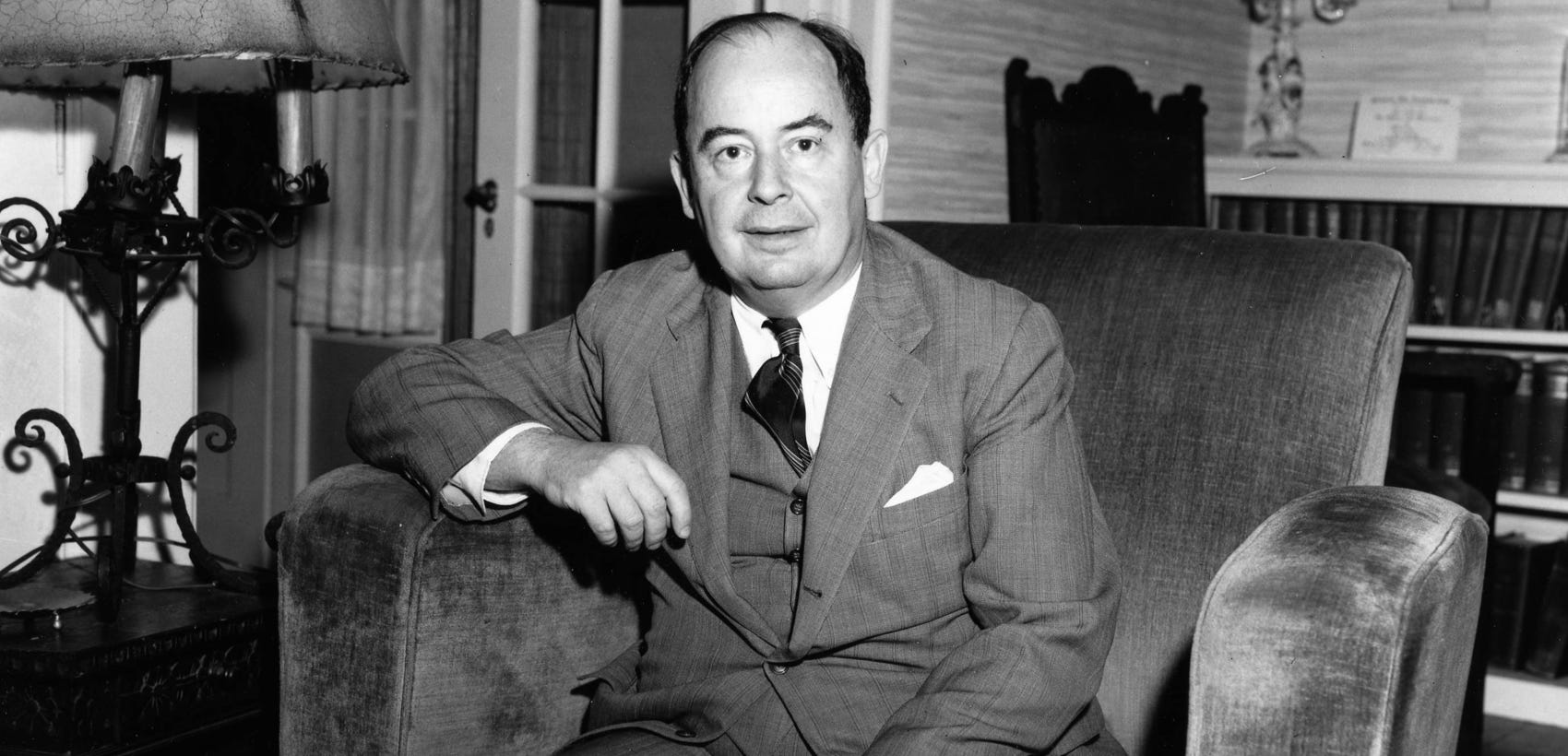
The Insecurity
of Genius
John von Neumann's profound fear of intellectual obscurity and his complex relationship with his own legacy
While there is no direct, verifiable quote from John von Neumann explicitly stating he would be forgotten while Albert Einstein and Kurt Gödel would be remembered, a significant body of evidence from his family, colleagues, and his own reflections confirms he was profoundly insecure about his intellectual legacy.
This anxiety was rooted in a combination of factors, including his own self-critical nature, a perceived lack of the kind of revolutionary originality seen in figures like Einstein, and the "subconscious feeling of extreme insecurity" he believed was a driving force for his generation of Hungarian scientists.
1. Direct Evidence of Intellectual Insecurity
1.1 Marina von Neumann Whitman's Account
Marina von Neumann Whitman, John von Neumann's only child, provided a poignant and authoritative account of her father's intellectual insecurities, particularly in the final years of his life. In a foreword to a collection of his letters, she explicitly stated that he became "deeply concerned about the question of his ongoing legacy."
The depth of this insecurity is further illustrated by an incident during von Neumann's final illness. As his cognitive abilities began to deteriorate due to cancer, he experienced a level of panic that his daughter described as "worse than any physical pain". His intellectual capacity was the "very essence of his being," and the prospect of losing it was terrifying.
In a heart-wrenching attempt to reassure himself, he asked his daughter to test him on simple arithmetic, such as adding two single-digit numbers.
This act of seeking validation for his most basic mental functions from a man who had once effortlessly manipulated the most complex abstract concepts is a powerful testament to his fear of losing the very thing that defined him.
1.2 Stanisław Ulam's Recollection
Stanisław Ulam, a prominent mathematician and one of von Neumann's closest friends and collaborators, corroborated the account of von Neumann's insecurity. This observation from a peer and friend is significant because it highlights a consistent character trait rather than a momentary lapse in confidence.
Ulam's recollections also provide context for the source of this insecurity. He and von Neumann often discussed the precarious situation in Europe during the 1930s, and it was in these conversations that von Neumann articulated his theory about the "Hungarian phenomenon."
"A coincidence of some cultural factors... an external pressure on the whole society of this part of Central Europe, a feeling of extreme insecurity in the individuals, and the necessity to produce the unusual or else face extinction"
This statement suggests that von Neumann saw insecurity not as a weakness, but as a powerful motivating force that shaped his entire generation of Hungarian scientists.
2. Indirect Evidence and Contextual Factors
2.1 Eugene Wigner's Comparison
Eugene Wigner, a fellow Hungarian physicist and a close friend of both von Neumann and Einstein, offered a particularly insightful and nuanced comparison of their respective intellectual gifts.
This distinction between von Neumann's "quick and acute" mind and Einstein's "deeper," "more penetrating," and "more original" mind is at the heart of the matter. It suggests that while von Neumann was a master at solving complex problems with incredible speed and efficiency, Einstein was a more profound and revolutionary thinker.
This comparison, coming from a respected peer and friend, likely reinforced von Neumann's own feelings of inadequacy and his fear that his work, while brilliant, would not be remembered as being as transformative as Einstein's.
2.2 Cultural and Societal Influences

John von Neumann himself offered a fascinating explanation for the remarkable concentration of scientific talent that emerged from Hungary in the early 20th century. He attributed their success to "a coincidence of some cultural factors" that created "a feeling of extreme insecurity in the individuals, and the necessity to produce the unusual or face extinction."
This "subconscious feeling of extreme insecurity," as he called it, was a driving force behind their relentless pursuit of excellence. By framing his own success in these terms, von Neumann was implicitly acknowledging the role that insecurity had played in his own life.
The Necessity of Excellence
"The tolerant climate of Hungary might change overnight... This constant threat of persecution propelled some to preternatural efforts to succeed."
The pressure to produce "unusual" work was immense, as it was the only way to stand out in a highly competitive and often hostile environment. This external pressure, combined with their own internal drive for excellence, created a powerful cocktail of ambition and anxiety.
3. Analysis of the Einstein-Gödel Claim
Important Note
While there is no direct, verifiable quote from John von Neumann explicitly stating he would be forgotten while Albert Einstein and Kurt Gödel would be remembered, the claim has gained traction through modern interpretations of his documented insecurities.
3.1 The Origin of the Claim
The specific claim that John von Neumann was convinced he would fade into obscurity while Albert Einstein and Kurt Gödel would be remembered appears to have originated from a blog post on the website LessWrong.
Key Issues with the Original Claim:
- No direct citations provided for the specific Einstein-Gödel comparison
- Based on synthesis of general insecurities rather than specific evidence
- Mixes documented facts with plausible but unverified inferences
3.2 Synthesis of Available Evidence
While the specific claim about Einstein and Gödel may be unverified, the broader context of von Neumann's insecurities is well-established. This general insecurity, coupled with his awareness of the revolutionary nature of Einstein's and Gödel's work, makes the comparison plausible.
The absence of a direct quote from John von Neumann on the specific comparison to Albert Einstein and Kurt Gödel is a significant gap in the evidence. Despite the wealth of biographical and historical material that has been written about him, there is no record of him ever having made such a statement.
Critical Analysis
The claim remains a plausible but unproven hypothesis, a testament to the enduring power of a good story, but not a statement of historical fact.
While it is tempting to accept a compelling story at face value, it is always important to ask for the evidence, to demand the kind of direct, verifiable proof that is the hallmark of good scholarship. In the case of the claim that von Neumann was convinced he would fade into obscurity while Einstein and Gödel would be remembered, the evidence is simply not there.
Conclusion
The evidence overwhelmingly supports the conclusion that John von Neumann was indeed profoundly insecure about his intellectual legacy, despite his monumental achievements across multiple fields of science and mathematics.
The testimonies of his daughter Marina von Neumann Whitman and his close friend Stanisław Ulam provide direct, first-hand accounts of his persistent anxiety about whether his work would endure. These are not speculative interpretations but documented observations from the people who knew him best.
Key Findings:
- Von Neumann was "surprisingly insecure about whether his work would still be recognised 'in a hundred years'"
- He experienced panic "worse than any physical pain" at the prospect of losing his intellectual capacity
- He attributed Hungarian scientific success to "a feeling of extreme insecurity" and "the necessity to produce the unusual or face extinction"
While the specific claim about Einstein and Gödel remains unverified, it represents a plausible synthesis of von Neumann's documented insecurities and his awareness of his contemporaries' revolutionary contributions. The absence of a direct quote does not diminish the reality of his profound anxiety about his place in history.
This complex portrait of a genius who never fully believed in his own lasting importance serves as a powerful reminder that even the most brilliant minds are not immune to self-doubt and the fear of being forgotten by history.