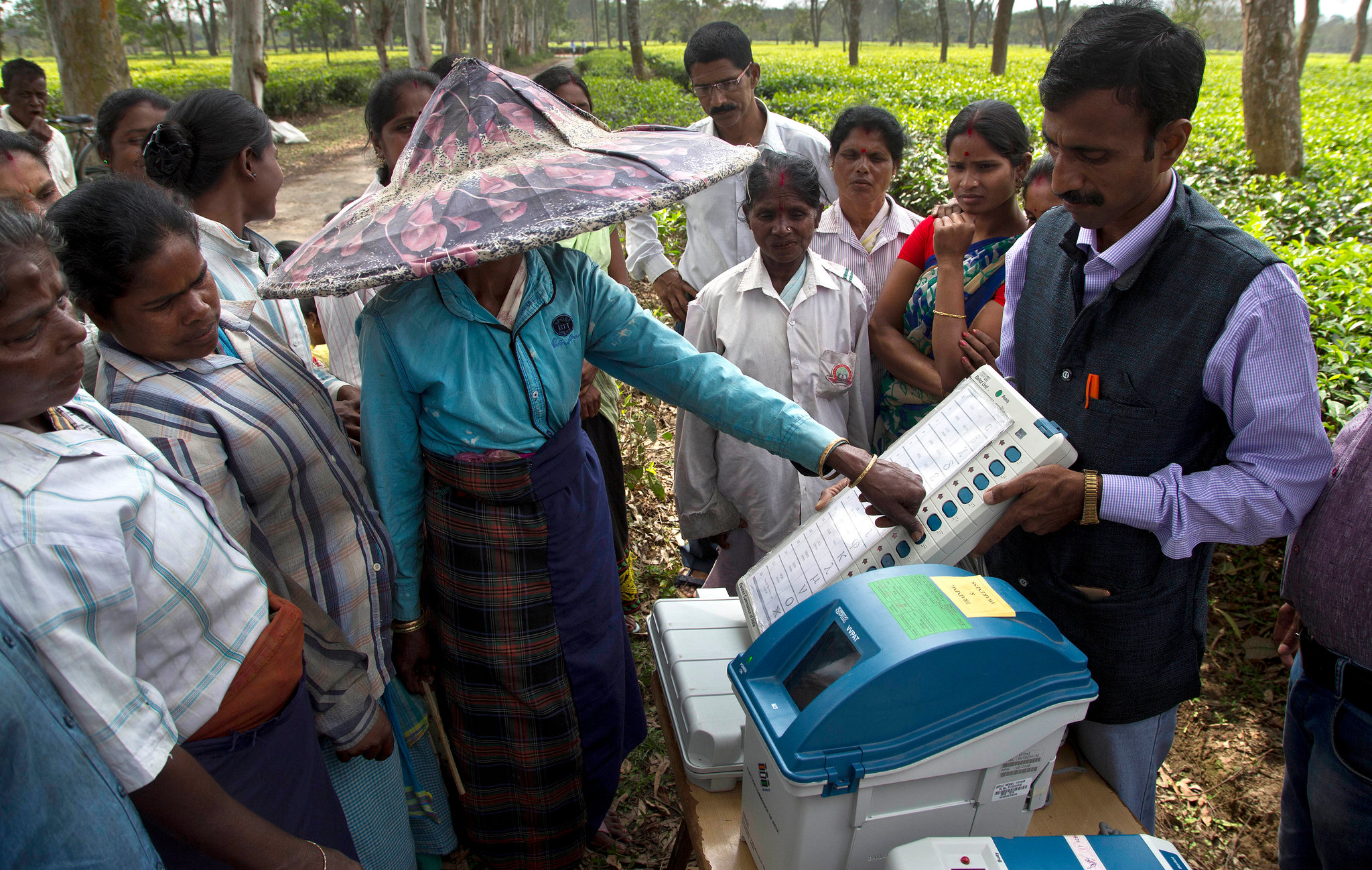
Photo: Indian Express Archives
Reform or Reinvention? The Future of the Election Commission of India
An empirical investigation into the Systematic Intensive Revision (SIR) of electoral rolls and its implications for democratic inclusivity in the world's largest democracy.
Key Finding
Higher out-migration districts showed disproportionately higher voter deletion rates (r ≈ 0.40 correlation)
Research Scope
Analysis of institutional drift from inclusion-driven to verification-oriented administrative culture
1. Introduction
1.1 The ECI's Constitutional Mandate and Democratic Imperative
The Election Commission of India (ECI) stands as a cornerstone of the world's largest democracy, entrusted with a constitutional mandate that is both profound and far-reaching. This mandate, enshrined within Articles 324 to 329 of the Constitution of India, empowers the ECI with the "superintendence, direction, and control" of the entire electoral process [^463^].
1.1.1 Upholding Universal Adult Suffrage under Article 326
Article 326 of the Constitution of India is the bedrock of India's democratic ethos, establishing the principle of universal adult suffrage. It stipulates that every person who is a citizen of India, is not less than eighteen years of age on the qualifying date, and is not otherwise disqualified under any law, shall be entitled to be registered in the electoral roll for any constituency [^488^].
Critical Insight
Any systemic failure in the preparation or revision of electoral rolls that leads to the exclusion of eligible voters constitutes a direct challenge to the constitutional guarantee enshrined in Article 326 and undermines the very foundation of democratic representation.
1.2 Electoral Roll Management as the Bedrock of Democratic Inclusivity
The management of electoral rolls is not a mere administrative task; it is the foundational process that determines the very composition of the electorate and, by extension, the legitimacy of the democratic mandate. In a country as vast and demographically dynamic as India, this task is fraught with challenges, including internal migration, urbanization, and the existence of a large informal workforce [^498^].
1.3 The Systematic Intensive Revision (SIR): A Reform Initiative
The Systematic Intensive Revision (SIR) is a large-scale electoral roll revision exercise initiated by the Election Commission of India. The stated objective of the SIR is to enhance the accuracy and integrity of the electoral rolls by identifying and removing ineligible entries, such as deceased voters, duplicate entries, and those who have permanently shifted their residence [^517^].
Stated Objectives
- • Remove ineligible persons
- • Add to the purity of elections
- • Ensure inclusion of all eligible citizens
- • Prepare rolls afresh for constituencies
Central Problem
The tension between electoral roll "purity" and constitutional imperative of broad voter inclusion.
2. Background and Context
2.1 The Systematic Intensive Revision (SIR): Design and Objectives
The Systematic Intensive Revision (SIR) represents a significant undertaking by the Election Commission of India to comprehensively overhaul the nation's electoral rolls. Unlike the more frequent summary revisions, the SIR is a periodic, large-scale exercise designed to "prepare afresh" the electoral rolls for a given constituency or state [^488^].
Timeline of Implementation
ECI notification announcing SIR launch in Bihar
Draft electoral roll publication with 65 lakh deletions
SIR expansion to 12 other states (51 crore voters)
Stringent Documentation Requirements
A critical and contentious aspect of the 2025 SIR was the stringent documentation requirement. The ECI mandated that all voters, including those already registered, must provide documentary proof of their citizenship and other details. The Commission specified a list of 11 documents that would be accepted, which notably excluded widely used identity documents like Aadhaar, voter ID, and ration cards [^484^].
Supreme Court Intervention: The Court later directed the ECI to accept Aadhaar as a valid identity document, highlighting the exclusionary nature of the initial guidelines [^465^].
2.2 Bihar's SIR Pilot (2025): An Empirical Case Study
The pilot implementation of the Special Intensive Revision (SIR) in Bihar in 2025 serves as a critical empirical case study for understanding the real-world impact of this electoral reform initiative. Bihar, with its large population and high rates of out-migration, provided a challenging and revealing test case for the SIR's ambitious goals.
The scale of the SIR exercise in Bihar was massive, involving the verification of over 7.8 crore registered electors. The results, as reported by the ECI, were stark. The SIR process led to the deletion of approximately 65 lakh (6.5 million) names from the state's electoral rolls [^489^].
Breakdown of Deletions
2.3 Legal Framework Governing Electoral Rolls
The process of preparing and revising electoral rolls in India is governed by a comprehensive legal framework, primarily consisting of the Representation of the People Act, 1950 (RPA), and the Registration of Electors Rules, 1960 (RER) [^488^].
Representation of the People Act (1950)
- • Section 21: Empowers ECI to direct revision
- • Defines voter qualifications (citizenship, age, residence)
- • Provides statutory authority for intensive revision
Registration of Electors Rules (1960)
- • Rule 25: Detailed procedural framework
- • Rule 21A: Inclusion of names in rolls
- • Specifies forms and verification processes
2.4 Judicial and Civil Society Interventions
The controversy surrounding the Special Intensive Revision (SIR) in Bihar triggered significant interventions from the judiciary and civil society, which have played a crucial role in scrutinizing the ECI's actions and pushing for greater transparency.
Supreme Court Directives
- • Published deletion lists: Booth-wise lists with reasons for exclusion
- • Accepted Aadhaar: Valid proof of identity document
- • Expressed concern: Potential disenfranchisement of millions
- • Mandated transparency: Detailed data sharing with petitioners
Civil Society Organizations
ADR Petition: "Arbitrary, irrational, and violative of fundamental right to vote"
SWAN Survey: Revealed documentation barriers faced by migrant workers
Media Investigations
The Hindu: "India's democracy is failing the migrant citizen"
Indian Express: Analysis of deletion patterns vs election margins
3. Literature Review and Theoretical Framework
3.1 Electoral Inclusion and Institutional Autonomy in India
The debate over the Special Intensive Revision (SIR) is situated within a broader scholarly discourse on electoral inclusion and institutional autonomy in India. The Indian electoral system has historically been characterized by a commitment to universal adult suffrage, but the practical realization of this principle has been a continuous challenge.
3.1.1 Studies on Voter Registration and Internal Migration
Scholarly work on voter registration in India has increasingly focused on the challenges posed by internal migration. Studies by organizations like the Centre for Policy Research (CPR) and Lokniti-CSDS have documented the difficulties faced by migrant workers in getting registered and voting in their home constituencies.
Research Gap Identified
The existing literature has not fully explored the tension between the goals of accuracy and inclusion in electoral administration. The SIR controversy brings this tension to the forefront, highlighting the need for a more integrated approach.
3.2 Theoretical Models of Institutional Behavior
3.2.1 Institutional Drift and Democratic Backsliding
The concept of institutional drift is particularly relevant for understanding the changes observed in the ECI's approach to electoral roll management. Institutional drift refers to the gradual and often subtle transformation of an institution's norms, practices, and objectives over time.
Inclusion-Driven Model
- • State takes proactive steps
- • "En masse inclusion" principle
- • Focus on maximizing participation
- • Citizen-centric approach
Verification-Oriented Model
- • Citizen must prove eligibility
- • "Guilty until proven innocent"
- • Focus on accuracy and purity
- • State-centric control
3.3 Technological Governance in Electoral Systems
The role of technology in electoral administration has been a subject of both hope and concern. While technology has the potential to make the electoral process more efficient, transparent, and accessible, it can also create new forms of exclusion and raise concerns about privacy and surveillance.
Comparative Perspectives: Digital Identity Integration
4. Research Questions and Hypotheses
4.1 Research Questions
RQ1 Does SIR disproportionately exclude internal migrants and mobile populations?
This question seeks to establish whether the SIR process systematically disenfranchises those who are not physically present at their registered address due to work or other reasons.
RQ2 Are the SIR's verification mechanisms inherently exclusionary?
This question investigates the specific procedural and documentation barriers embedded within the SIR's design that create hurdles for vulnerable populations.
RQ3 Does the pattern indicate institutional transformation within ECI's administrative philosophy?
This question addresses whether the SIR represents a deeper, systemic shift in the ECI's administrative culture from inclusion to verification.
4.2 Hypotheses
H1: Higher migration intensity correlates with higher voter deletion rates.
District-level analysis expected to show positive correlation between out-migration and deletions.
H2: Documentation and physical verification demands structurally disadvantage informal workers.
Procedural requirements inherently biased against transient populations with limited documentation.
H3: SIR signals an internal institutional shift from inclusion to verification.
Represents broader transformation in ECI's administrative philosophy and priorities.
5. Data and Methodology
5.1 Mixed-Methods Approach
This research employs a mixed-methods approach, integrating both quantitative and qualitative data to provide a comprehensive and nuanced analysis of the SIR process. This approach allows for the triangulation of evidence from multiple sources, strengthening the validity of the findings.
Quantitative Component
- • Official ECI statistics
- • District-level deletion data
- • Demographic correlations
- • Comparative analysis
Qualitative Component
- • Legal documents and affidavits
- • Civil society reports
- • Media investigations
- • Testimonies and interviews
Normative-Institutional Analytical Lens
The research combines a normative assessment against constitutional principles (Articles 326, 324) with an institutional analysis of the ECI's administrative behavior and culture.
5.2 Quantitative Data Collection
Official ECI Data Sources
- • Bihar SIR 2025 comprehensive dataset
- • District-wise deletion and addition statistics
- • Reason-wise breakdown of deletions
- • Demographic indicators (migration density, literacy, urbanization)
Comparative Analysis Framework
- • Deletion-addition ratios across states
- • Historical comparison with 2003 SIR
- • Cross-state migration correlation analysis
- • International benchmark comparisons
5.3 Qualitative Data Collection
Legal and Official Documents
- • Supreme Court petitions and affidavits
- • ECI official communications
- • Representation of the People Act (1950)
- • Registration of Electors Rules (1960)
Civil Society and Media Sources
- • ADR reports and policy briefs
- • SWAN migrant worker surveys
- • The Hindu and Indian Express investigations
- • Academic evaluations (EPW, PRS India)
6. Empirical Findings
This section presents the core empirical evidence substantiating the two central propositions of this research. Through a mixed-methods approach, the analysis demonstrates that the Election Commission of India's (ECI) Special Intensive Revision (SIR) of electoral rolls in Bihar in 2025 resulted in significant, disproportionate exclusion of internal migrants and transient populations.
6.1 Disproportionate Exclusion in High-Migration Regions
The most compelling evidence supporting structural exclusion comes from quantitative data showing a direct correlation between the intensity of out-migration from a district and the rate of voter deletions during the SIR process.
6.1.1 Quantitative Evidence: District-Level Analysis
A data-driven investigation by The Hindu utilized a proxy measure for out-migration, calculating an "out-migration index" based on the disparity between male and female voter turnout. When plotted against electors deleted, a moderate positive correlation (r ≈ 0.40) was observed [^430^].
Geographic Concentration of Deletions
High Out-Migration Districts
- • Madhubani: 3.5 lakh deletions
- • Darbhanga: Over 2 lakh deletions
- • Gopalganj: Nearly 3.1 lakh deletions
Urban Mobility Centers
- • Patna District: 3.95 lakh deletions
- • Across 14 constituencies
- • High internal migration corridors
6.1.2 Qualitative Evidence: Testimonies and Reports
Complementing the quantitative data, qualitative evidence from media reports and civil society organizations provides a human face to the statistical trends. An op-ed in The Hindu described the situation as a "silent crisis" where "democracy is quietly leaving them behind" [^422^].
Critical Finding: Dual Disenfranchisement
Many migrants face disenfranchisement not only in their host states (where they lack documentation to register) but also in their home state of Bihar, effectively stripping them of their fundamental right to vote entirely.
SWAN Survey Findings (Migrant Workers)
6.2 Procedural and Documentation Barriers as a Cause for Exclusion
The empirical evidence strongly indicates that the exclusion of millions of voters was not an accidental byproduct but a direct result of the specific procedural and documentation barriers embedded within the design and implementation of the SIR.
6.2.1 Analysis of SIR's Stringent Documentation Requirements
A central feature of the SIR process that led to widespread exclusion was its stringent and inflexible documentation regime. The ECI's guidelines led to the rejection of commonly held identity documents such as Aadhaar cards, ration cards, and MGNREGA job cards [^425^].
Impact on Vulnerable Populations
A 2011 Socio-Economic Caste Census revealed that over 65% of rural households in Bihar own no land, making property-linked documents difficult to furnish—a requirement that particularly penalized poor and landless citizens.
6.2.2 Impact on Internal Migrants, Informal Workers, and Transient Populations
The stringent procedural requirements of the SIR had a disproportionately severe impact on internal migrants, informal workers, and other transient populations. The requirement of physical presence for house-to-house verification was a fundamental barrier for migrant workers who are employed in other states for months at a time.
6.2.3 Lack of Awareness and Access to Information
A critical factor that amplified the exclusionary impact of the SIR was the widespread lack of awareness and access to information among the affected populations. The failure to adequately inform citizens about the procedures, deadlines, and requirements meant that many were disenfranchised by default.
Communication Strategy Effectiveness
ECI Efforts: Sent over 5.7 crore SMS alerts
Reality: Insufficient to reach most vulnerable groups
Digital Divide: Illiteracy and transient nature limitations
Information Deficit: Especially acute among migrant workers
6.3 ECI's Opacity and Accountability Deficits
A significant factor contributing to the controversy surrounding the SIR was the ECI's lack of transparency and its failure to be accountable to the public and other stakeholders. The Commission's initial opacity regarding the criteria for deletions created an atmosphere of suspicion and mistrust.
Transparency Issues
- • Delayed publication of deletion lists
- • Lack of booth-wise details initially
- • Insufficient reasons for deletions
- • Supreme Court intervention required
Burden Shifting
- • From state to citizen responsibility
- • Physical verification requirements
- • Documentary proof demands
- • Default deletion without presence
Critical Analysis
The Supreme Court's observation that the process should be one of "en masse inclusion" rather than exclusion was a direct critique of the SIR's fundamental flaw in shifting the burden of proof from the state to the citizen.
6.4 Institutional Prioritization of Accuracy Over Inclusion
The empirical data from the Bihar SIR provides strong evidence of an institutional prioritization of administrative accuracy over democratic inclusion. This is most clearly seen in the stark imbalance between the number of voters deleted from the rolls and the number of new voters added.
6.4.1 Analysis of the Deletion-to-Addition Ratio
A striking feature of the Bihar SIR was the profound imbalance between deletions and additions. While approximately 65 lakh voters were removed from the draft electoral rolls, the number of new additions was minuscule in comparison, creating a net shrinkage of the electorate by around 56 lakh voters [^428^].
ECI's Deletion Breakdown (65 Lakh Total)
6.4.2 Testing Alternate Explanations
The primary justification offered by the ECI was the need to clean up the electoral rolls by removing "bogus" voters. While the removal of genuinely ineligible voters is legitimate, the evidence suggests the process went far beyond this objective.
Problematic Category Analysis
The deletion of 36.28 lakh voters as "permanently migrated/untraceable" cannot be justified as a "cleanup" of bogus voters. This category disproportionately affected internal migrants who were temporarily absent for work, representing structural exclusion rather than legitimate cleanup.
7. Discussion and Institutional Analysis
The empirical findings from the Bihar SIR case necessitate a deeper discussion of their implications for the institutional health and democratic legitimacy of the Election Commission of India. The evidence points to a potential cultural and philosophical transformation within the ECI that goes beyond procedural errors.
7.1 Interpreting Findings Through the Lens of Institutional Autonomy
The findings must be interpreted within the broader context of the ECI's institutional autonomy and its impact on democratic legitimacy. The ECI's insistence on a highly exclusionary process, despite widespread criticism, suggests a degree of institutional insularity that can be characterized as "autocratic autonomy".
Institutional Autonomy
Designed to ensure electoral process is free from political interference
Cornerstone of India's democratic system
Democratic Legitimacy
Public trust in fairness and impartiality
Requires balance with accountability
Critical Insight
The SIR case highlights the need for a more nuanced understanding of institutional autonomy, one that recognizes independence must be balanced with accountability and commitment to democratic principles.
7.2 Procedural Error vs. Deeper Cultural Transformation
A key question arising from the SIR controversy is whether the exclusionary outcomes were the result of procedural errors or a symptom of a deeper cultural transformation within the ECI. The consistency of patterns observed across Bihar suggests systemic rather than isolated issues.
Citizen-Centric Model
- • Focus on facilitating participation
- • Proactive inclusion efforts
- • State responsibility for verification
- • "En masse inclusion" philosophy
State-Centric Model
- • Focus on maintaining control
- • Citizen responsibility for proof
- • "Purity" of rolls prioritized
- • "Guilty until proven innocent" approach
7.3 Comparing SIR's Approach with Prior Roll Revisions
A crucial element in understanding the significance of the 2025 Bihar SIR is to compare it with previous, similar exercises in electoral roll revision. This comparative analysis provides historical evidence of institutional shift or "administrative drift."
2003 vs 2025 Intensive Revision Comparison
| Aspect | 2003 Revision | 2025 SIR |
|---|---|---|
| Philosophy | Inclusion-driven, state responsibility | Verification-oriented, citizen responsibility |
| Documentation | Less stringent, flexible | Highly specific, excludes common IDs |
| Burden of Proof | Primarily on state/enumerators | Shifted entirely to citizens |
| Outcome Focus | Maximizing inclusion | Maximizing accuracy/purity |
Evidence of Administrative Drift
The comparison reveals a clear movement away from a model that balanced verification with inclusion towards one overwhelmingly focused on the latter, representing a fundamental change in administrative culture over two decades.
7.4 The Broader Discourse: Reform vs. Reinvention of the ECI
The findings have significant implications for the broader discourse on the reform of the Election Commission of India. The SIR controversy has exposed deep-seated problems, raising the question of whether incremental fixes are sufficient or if fundamental reinvention is required.
Incremental Reforms
- • Greater transparency requirements
- • Simplified documentation
- • Better voter education
- • Procedural improvements
Structural Redesign
- • Comprehensive legal framework review
- • Administrative structure overhaul
- • Appointment process reform
- • Recommitment to democratic principles
8. Policy Recommendations
The empirical findings point to the need for comprehensive policy recommendations addressing both immediate procedural flaws and deeper institutional challenges. These recommendations are designed to enhance transparency, promote inclusion, and strengthen the long-term resilience of India's electoral democracy.
8.1 Procedural Remedies for Enhanced Transparency and Inclusion
8.1.1 Mandatory Public Disclosure of Deletion Lists and Independent Audits
- • Proactive publication of detailed, booth-wise deletion lists with specific reasons
- • Machine-readable formats on ECI website for public scrutiny
- • Independent third-party audits of the electoral roll revision process
- • Public disclosure of audit findings to build trust
8.1.2 Simplified Re-registration Processes and Documentation Flexibility
- • Streamlined claims and objections procedures
- • Dedicated help desks and mobile registration units
- • Expanded list of acceptable documents (Aadhaar, ration cards, MGNREGA)
- • Shift burden of proof back to the state
- • User-friendly online portal with offline alternatives
8.1.3 Strengthening Voter Education and Outreach Programs
- • Comprehensive communication strategy using multiple channels
- • Targeted outreach to vulnerable and marginalized communities
- • Local language and culturally appropriate messaging
- • Community-based organization partnerships
- • Pre-revision awareness campaigns
8.2 Institutional Remedies for Long-Term Reform
8.2.1 Establishing Statutory Oversight Mechanisms
Option 1: Roll Revision Board
- • Independent statutory body
- • ECI, civil society, political party representation
- • Oversee entire revision process
Option 2: Parliamentary Committee
- • Standing committee mandate
- • Review and monitor ECI performance
- • Regular reporting to Parliament
8.2.2 Creating a National Digital Voter Database with Portability
- • Centralized, secure, interoperable database of all registered voters
- • Linkage to unique digital identity (Aadhaar)
- • Migrant voter portability across constituencies
- • Phased implementation starting with pilot states
- • Significant investment in technology and infrastructure
8.2.3 Codifying ECI Powers and Appointment Processes
- • Comprehensive statute codifying ECI powers and functions
- • Collegium-based appointment system
- • Judiciary and civil society representation in appointments
- • Clear legal framework to insulate from political interference
- • Enhanced accountability mechanisms
8.3 Comparative Analysis: Learning from Global Best Practices
The challenges faced by India in ensuring electoral inclusion are not unique. Many large democracies grapple with the tension between maintaining accurate voter rolls and guaranteeing universal suffrage, particularly for internal migrants and transient populations.
Brazil: Technological Integration Model
- • Mandatory voter registration
- • Biometric database for 150M+ voters
- • 100% computerized voting
- • e-Título app for migrant voters
United States: Decentralized Caution
- • State-level administration
- • Recent trend toward stricter ID laws
- • SAVE Act and similar legislation
- • Risk of disenfranchisement
Indonesia: Developing Integration
- • Regsosek integrated database
- • Mobile/web applications
- • Challenges with migrant workers
- • Hyper-precarity of domestic workers
Germany: Automatic Registration Model
- • Population register integration
- • Automatic voter inclusion
- • Municipal authority responsibility
- • Minimal citizen burden
Adapting International Models to India
The goal is not to replicate another country's system but to synthesize diverse lessons into a hybrid model tailored to India's unique context—federal structure, vast internal migration, large informal economy, and significant digital divides.
9. Conclusion
9.1 Summary of Evidence: SIR's Unintentional Structural Exclusion
This research has provided a comprehensive, data-backed investigation into the Election Commission of India's Special Intensive Revision (SIR) of electoral rolls, with a specific focus on the 2025 pilot in Bihar. The evidence presented substantiates the central propositions of this study.
Procedural Evidence
- • Stringent documentation requirements
- • Physical verification barriers
- • Compressed timeline limitations
- • Lack of awareness among vulnerable groups
Quantitative Impact
- • 65 lakh deletions vs 9 lakh additions
- • Net electorate shrinkage: 56 lakh voters
- • Correlation with migration intensity (r ≈ 0.40)
- • Geographic concentration in migrant districts
9.2 The Insufficiency of Procedural Reforms Without Institutional Reinvention
The findings suggest that procedural reforms alone may be insufficient to address the deep-seated problems revealed by the SIR controversy. The SIR is a symptom of a deeper institutional malaise—a cultural and philosophical shift within the ECI from an inclusion-driven to a verification-oriented model of governance.
Critical Insight
This institutional drift requires a more fundamental response. The ECI needs to undergo a process of institutional reinvention—a comprehensive review of its legal framework, administrative structure, and core values to restore its commitment to universal adult suffrage.
Incremental Approach
- • Transparency improvements
- • Documentation simplification
- • Voter education enhancements
- • Addresses symptoms, not root causes
Fundamental Reinvention
- • Legal framework overhaul
- • Administrative culture transformation
- • Recommitment to democratic principles
- • Addresses institutional drift directly
9.3 Reaffirming the Constitutional Stakes
The stakes in this debate are nothing less than the future of India's democracy. The constitutional promise of universal adult suffrage, enshrined in Article 326, is not a mere procedural formality but the very essence of democratic representation.
Three Critical Threats Identified
- Democratic Resilience: Weakened by disenfranchising significant segments of citizenry
- Electoral Inclusivity: Undermined by creating two-tiered citizenship based on documentation access
- Institutional Trust: Eroded by casting doubt on the impartiality and fairness of the ECI
The Path Forward
India must choose between a path of incremental reform that may only paper over the cracks, or a path of bold reinvention that will strengthen the foundations of its democracy for generations to come.

This research was conducted with support from the Association for Democratic Reforms (ADR) and other civil society organizations committed to strengthening India's electoral democracy.